QNAP TS‑873A NAS Review: Secure, Scalable, and Business‑Ready 8‑Bay Powerhouse
Introduction
Network-Attached Storage (NAS) systems have become essential for modern organizations that demand not just high-capacity storage, but also data integrity, resilience, and security. If you’re seeking a secure and scalable desktop NAS solution, the QNAP TS-873A NAS offers one of the most refined 8‑Bay systems currently on the market. Blending mature hardware design with QuTS Hero’s ZFS reliability and multi-layered cybersecurity, the TS‑873A positions itself as a versatile solution for surveillance, virtualization, and secure file management in hybrid IT environments.
This review delves into every aspect of the TS‑873A, from unboxing and internal components to software and security functionality guiding IT professionals, penetration testers, and system architects through the strengths and potential trade-offs of this solution.
Retail Packaging and First Impressions
The TS‑873A arrives in understated yet robust retail packaging typical of QNAP’s SMB-tier hardware. The box is nearly twice the size of the NAS itself, designed to endure the rigors of international shipping. Inside, dense packing foam and thoughtful placement protect the device against impact-related damage, which is critical for sensitive 24×7 operational hardware that could suffer long-term instability from shipping shocks.
Unlike more consumer-facing models, this NAS isn’t intended for shelf appeal its unassuming design emphasizes function over flash. Still, there’s detailed labeling of hardware features, supported protocols, and software capabilities. This business-first packaging aligns with how many IT departments and small-to-medium businesses (SMBs) make purchasing decisions based on spec-to-cost ratio, not consumer aesthetics.
The accessory bundle includes everything needed for initial deployment: a power cord, two Cat 5e Ethernet cables, keys for the drive bays, screws for both 2.5″ and 3.5″ drives, M.2 SSD heatsinks, and basic documentation with a QR code for full setup support online. Notably, the inclusion of thermal pads for the M.2 slots is a thoughtful security and performance consideration. Heat buildup can cause throttling and data corruption in SSD-based caches, which in turn could impact virtualization stability or surveillance write speeds.
Hardware Overview: Design and Build
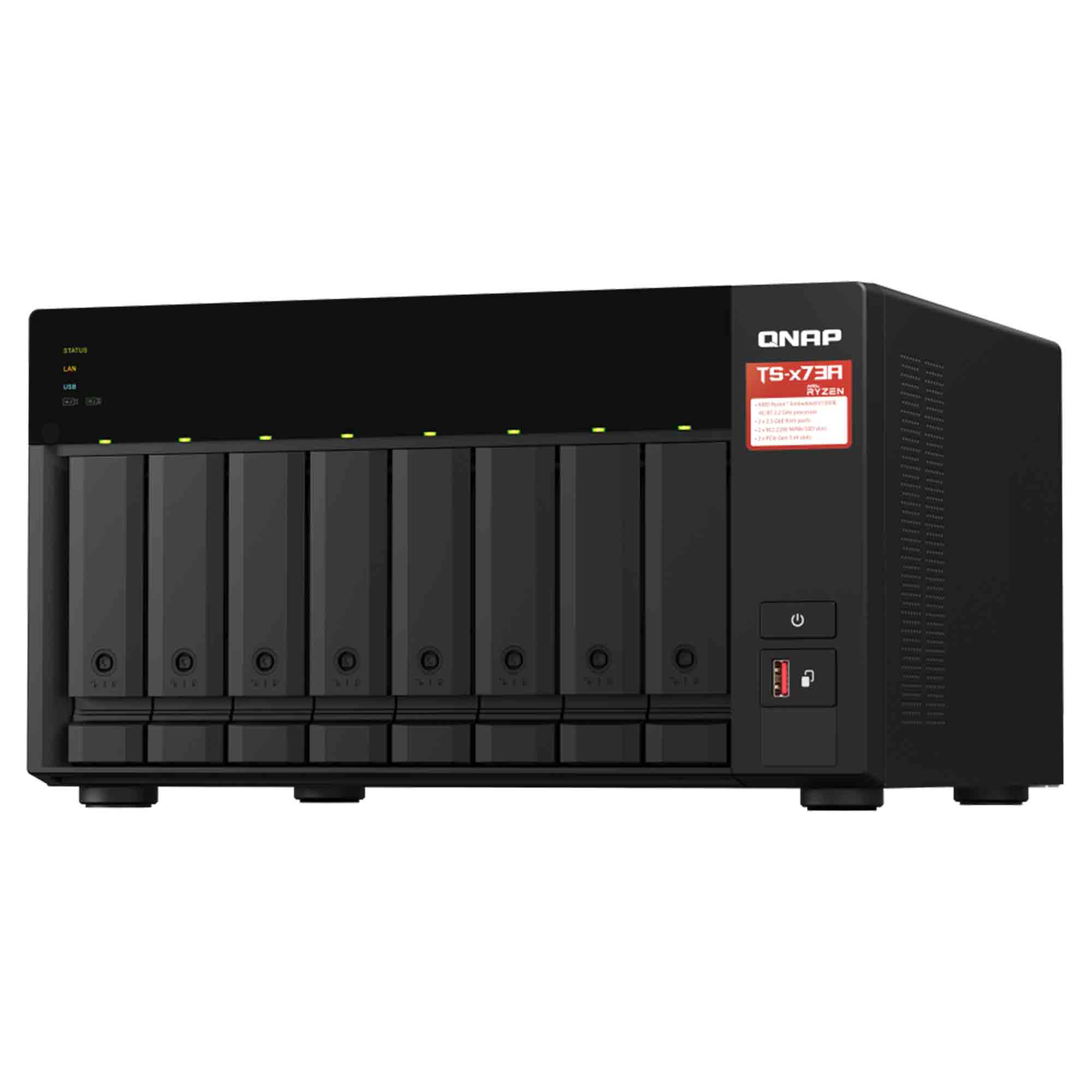
The TS‑873A shares chassis lineage with previous QNAP 8-bay models, balancing industrial build quality with accessible design. The unit features a metal housing that enhances durability and doubles as a passive heat sink. This rugged enclosure also provides electromagnetic shielding useful in environments where clean signal paths and hardware integrity are essential.
Although there’s no front-facing LCD panel, the device offers an array of LED indicators for drive activity, system status, and network health. These indicators can help security teams quickly triage issues without logging into the management interface. The USB 3.2 Gen 2 front port rated for 10 Gbps is paired with a copy button, ideal for fast local backups. For those maintaining incident response or air-gapped backups, this front port offers speed and convenience without needing console access.
Each of the eight drive bays supports up to 18 TB SATA HDDs, with support for higher-capacity drives expected as firmware updates roll out. The trays are plastic but lockable, striking a balance between weight and functionality. The locking mechanism deters casual tampering but should be augmented with software-level access control and physical rack security in sensitive deployments. Internally, the SATA backplane is cleanly routed, with no hanging connectors or airflow obstructions crucial for reliable 24/7 operation.
The unit uses plastic trays for both 3.5″ HDDs and 2.5″ SSDs, with tool-less mounting for the former. This design streamlines deployment, especially in scenarios where speed is essential such as spinning up secure data nodes during incident response or forensic logging operations.
Thermal Management and Chassis Cooling
The TS‑873A’s thermal design is well-engineered for continuous operation. It includes two large 120 mm rear fans for bulk airflow and a dedicated 60 mm fan to cool the CPU, RAM, and M.2 slots. This segmentation helps maintain stable thermal zones a must when operating under encrypted workloads or active VM deployment.
Temperature regulation is especially important when deploying inline data deduplication or operating large surveillance environments, where thermal spikes can degrade both performance and reliability. Fan speeds are auto-regulated by default but can be manually adjusted if operating in noise-sensitive areas.
For users seeking ultra-quiet operation without compromising cooling performance, replacing the default rear fans with two Noctua NF‑A12x25 LS‑PWM fans is highly recommended. These 120×120×25 mm PWM fans feature advanced Sterrox® LCP blades with a tight 0.5 mm tip clearance and Flow Acceleration Channels, delivering efficient airflow and static pressure simultaneously. Operating at just 1,200 RPM (or 900 RPM with the included Low‑Noise Adaptor), they move 55.7 m³/h of air at only 12.1 dB(A), reducing to an almost inaudible 7.6 dB(A) when slowed ideal for silent environments. The fans use Noctua’s high-precision SSO2 bearing and CNC-milled brass shell for longevity (MTTF over 150,000 h), while the NE‑FD1 PWM controller enables full-stop at 0 % PWM for semi-passive cooling at idle. They include anti-vibration gaskets (for radiator-style mounting), Y-cables, and 30 cm extensions delivering superior acoustic performance and thermal stability in a business-grade NAS chassis:contentReference[oaicite:1]{index=1}.
Connectivity and Network Architecture
Rear I/O on the TS‑873A is pragmatic and security-focused. It includes two 2.5GBASE-T ports for high-speed network access, with support for Link Aggregation, Failover, and VLAN tagging enabling segmented traffic for management, VM access, and surveillance streams. The omission of HDMI reflects the NAS’s business intent; there’s no emphasis on multimedia, focusing instead on headless server operation with secure remote access.
Three USB ports two Gen 2 and one Gen 1 (USB-C) allow for external storage, UPS connectivity, or hardware-based security tokens. Internally, two PCIe Gen 3 x4 slots support upgrades like 10 GbE NICs, Fibre Channel, or GPU accelerators. QNAP’s support for Intel and Mellanox cards, as well as its own QM2 modules, ensures broad compatibility. Just note that power limitations restrict GPU options, so stick to models suited for headless acceleration (e.g., for AI analytics or virtual desktop hosting).
Internal Hardware and System Performance
Under the hood, the TS‑873A is powered by the AMD Ryzen V1500B quad-core processor. This 64-bit x86 chip supports hardware virtualization, AES-NI encryption acceleration, and ECC memory. Although it lacks an embedded GPU, its performance is optimized for multi-threaded applications perfect for virtual machines, surveillance workloads, and secure cloud backup operations.
The system ships with 8 GB of DDR4 RAM in a single SODIMM but supports upgrades up to 64 GB. ECC memory is also supported, reducing the risk of data corruption a crucial benefit in ZFS file systems and secure transactional environments. Security professionals will appreciate this feature when running long-term audits or compliance-sensitive operations.
The NAS includes two M.2 NVMe SSD bays for caching or tiered storage. Each bay is PCIe Gen 3 x1, limiting speeds to ~1 GB/s. While this may seem restrictive, using them in RAID 0 or with compression and deduplication still yields significant performance improvements for metadata-heavy or high-IOPS scenarios like SIEM storage or log aggregation.
For maximum system responsiveness, especially for the OS, applications, and downloads we recommend installing 2 × 4 TB Samsung 9100 Pro with heatsink SSDs in a RAID‑0 (stripe) configuration. These PCIe 5.0 NVMe M.2 drives deliver stunning sequential read/write speeds up to 14,800/13,400 MB/s and random IOPS of 2.2 M/2.6 M. Backed by 4 GB of LPDDR4x cache and AES‑256 encryption (TCG/Opal v2.0), they pair blazing performance with enterprise-grade security. The included heatsink ensures sustained thermal control and efficiency maintaining peak performance levels even under heavy workloads like VM deployments or large file transfers.
To fully leverage the storage capabilities of the TS‑873A, we recommend populating the unit with eight Seagate Exos X24 24TB drives, configured in a ZFS RAID 5 array under QuTS Hero. These enterprise-grade HDDs offer up to 24TB of helium-sealed capacity each, delivering 285MB/s sustained throughput and a 2.5 million hour MTBF for high-reliability deployments. Equipped with PowerBalance™ efficiency and Seagate Secure™ encryption features, Exos X24 drives are optimized for dense, hyperscale storage environments. This configuration ensures both high capacity and data integrity, ideal for secure virtualization, long-term compliance archiving, or centralized surveillance storage workflows.
Enhance GPU-Accelerated Workloads
To further boost the TS‑873A’s multimedia and AI processing capabilities, consider adding the MSI GeForce RTX 3050 LP 6G OC via the PCIe Gen 3 slot. This low-profile, dual-fan card delivers 6 GB GDDR6 (14 Gbps) VRAM, 2 304 CUDA cores, and a power draw of just 70 W perfect for the TS‑873A’s chassis and power envelope. Its Ampere architecture includes a 7th-generation NVENC encoder and 5th-generation NVDEC decoder, ideal for hardware-accelerated video tasks like Plex transcoding.
By passing it through to a VM or container, you can offload 4K transcoding tasks from the CPU enhancing streaming performance and reducing system load. Plex officially supports NVIDIA GPUs on QNAP devices using their NVIDIA_GPU_DRV package, and community setups (from TrueNAS to Proxmox) have demonstrated seamless GPU passthrough for Plex. This makes the RTX 3050 LP a smart, compact upgrade for hybrid NAS setups requiring both secure storage and efficient media or AI processing.
Software Stack and Cybersecurity Features
The TS‑873A ships with QNAP’s QuTS Hero operating system, which is built on the ZFS file system. This platform emphasizes data integrity, self-healing mechanisms, and advanced storage functionality. ZFS checksums every block and supports end-to-end data verification, making it highly resilient against bit rot and silent data corruption an advantage in secure archival and forensic environments.
From a cybersecurity perspective, QuTS Hero includes numerous features out of the box:
- Snapshot Management: Quickly revert to previous states in the event of ransomware attacks or accidental deletion.
- Inline Compression & Deduplication: Save space and prevent redundant data proliferation.
- Role-Based Access Control (RBAC): Granular user permissions help enforce least privilege principles.
- Encrypted Volumes & SSL Management: Ensures data-at-rest and data-in-transit remain protected.
- Two-Factor Authentication (2FA): Adds an additional access security layer for the management console.
Security-conscious users can also leverage QNAP’s Security Counselor tool, which acts as an onboard audit system analyzing settings and suggesting improvements. Integration with antivirus and anti-malware tools from ClamAV and McAfee allows layered threat detection, and firmware updates are regularly pushed to close vulnerabilities.
The system also supports Virtualization Station and Container Station, enabling secure workload isolation. Users can deploy Windows, Linux, or Android VMs, or run Docker/LXC containers in a sandboxed environment, useful for testing security tools, malware analysis, or deploying honeypots.
Other highlights include:
- Hybrid Backup Sync 3: Automate and encrypt backups to cloud services or remote NAS systems.
- QVPN Service: Set up VPN tunnels to secure remote access and inter-office data transfers.
- QVR Pro: 8-camera surveillance suite with AI add-ons for face and behavior recognition ideal for SOC environments.
Cybersecurity incidents continue to escalate across industries, highlighting the urgent need for secure data infrastructure. A prime example is the ransomware attack on Kawasaki Motors Europe, which exposed significant vulnerabilities in enterprise systems. Incidents like this reinforce the importance of building resilient backup strategies and implementing tamper-resistant snapshot capabilities in NAS environments. Deploying solutions like the QNAP TS‑873A NAS with ZFS and snapshot protection can help mitigate such risks by enabling fast recovery and minimizing data loss.
Why Choose QuTS Hero: The Enterprise Advantage of ZFS
QNAP’s QuTS Hero operating system elevates the NAS experience by integrating the advanced ZFS file system with the usability of QNAP’s familiar interface. Designed for enterprise-grade reliability, QuTS Hero transforms a NAS from mere storage into a secure, high-performance data platform. Unlike traditional ext4-based systems (like QTS), QuTS Hero offers end-to-end data integrity, native support for inline deduplication, compression, and robust snapshot versioning.
One of ZFS’s most critical advantages is its ability to detect and correct silent data corruption through checksumming. This capability is essential for security-focused environments where undetected bit rot can compromise forensic evidence, backup validity, or compliance archives. Furthermore, self-healing capabilities ensure that even when faults occur, ZFS reconstructs data automatically from parity, keeping your data trustworthy and intact.
QuTS Hero also enables massive scalability supporting petabyte-level storage, thousands of snapshots, and tiered SSD caching. It integrates seamlessly with QNAP’s virtualization and container platforms, allowing resource-intensive VMs and apps to benefit from performance gains delivered by ZFS features like ARC and L2ARC caching, synchronous writes via ZIL, and block-level deduplication.
Security professionals will value the OS’s support for encrypted volumes, role-based access control (RBAC), and immutable snapshots that protect against ransomware and insider threats. Combined with ECC memory and powerful processors, QuTS Hero offers a hardened architecture ready for critical workloads from security analytics to long-term data archival under regulatory constraints.
Finally, features like Security Counselor, Hybrid Backup Sync, and integrated anti-malware tools ensure the platform remains resilient and secure. For businesses, MSSPs, or any organization prioritizing data durability and security-first architecture, QuTS Hero is the strategic choice over QTS.
TVS‑h874 (i9) vs TS‑873A (Ryzen)
At first glance, QNAP’s newer TVS‑h874 series may appear more powerful, featuring up to a 16-core/24-thread Intel Core i9 CPU, 64 GB DDR4 RAM, and dual 10 GbE ports. It also includes HDMI output and Intel UHD Graphics, making it attractive for multimedia tasks and local display use. However, a critical limitation lies beneath the surface: Intel Core CPUs do not support ECC memory. This architectural constraint prevents the TVS‑h874 from running QuTS Hero with the ZFS file system, eliminating access to essential enterprise-grade features such as checksumming, self-healing, and inline deduplication.
In contrast, the TS‑873A, powered by the AMD Ryzen V1500B, does support ECC memory up to 64 GB via 2 x 32 GB SO-DIMM modules. This capability is not optional; it’s foundational for ZFS to function correctly. ECC ensures memory integrity, allowing ZFS to verify and correct data in real time, maintaining reliable storage and reducing the risk of silent data corruption. With ECC, QuTS Hero can offer true end-to-end data protection, a cornerstone for any security-focused deployment.
Both models support advanced virtualization, M.2 NVMe caching, PCIe expansion, and even GPU upgrades. Yet, only the TS‑873A enables these features within the robust, integrity-focused environment that QuTS Hero provides. While the TVS‑h874 may lead in raw CPU horsepower, it falls short in areas that matter most to IT professionals, system architects, and compliance-driven teams.
Bottom line: The TS‑873A is the smarter, more resilient choice for long-term NAS deployments that demand data integrity, regulatory compliance, and ZFS-enabled performance. When ECC memory and QuTS Hero support are mission-critical, newer isn’t always better.
Conclusion and Deployment Recommendations
The QNAP TS‑873A stands out as a mature, security-focused NAS for professionals who require more than just large storage capacity. Its AMD Ryzen architecture, ECC memory support, PCIe expandability, and built-in virtualization capabilities make it a future-proof solution that grows alongside business needs.
Security-conscious users will especially benefit from its ZFS-based QuTS Hero OS, which offers snapshot versioning, RAID-Z redundancy, inline deduplication, and compression all critical features for safeguarding sensitive data in enterprise, government, or regulated environments.
As organizations scale their data operations, the TS‑873A can evolve from a basic file server into a robust private cloud, virtualization host, or even a surveillance command center with QVR Pro. Whether you’re archiving compliance data, hosting secure applications, or backing up hybrid-cloud infrastructure, this NAS is built to deliver.
Actionable Takeaways
- Upgrade to 64 GB ECC RAM to unlock full ZFS features, including inline deduplication and higher virtualization workloads.
- Deploy Hybrid Backup Sync with encryption to automate 3-2-1 compliant backups across cloud and offsite targets.
- Enable Security Counselor and Firewall to harden the NAS against known vulnerabilities and brute-force login attempts.
- Install QVPN for secure remote workforce access or secure inter-office syncing over public networks.
- Use Container Station to sandbox pentest tools or deploy security-centric microservices like Suricata or Zeek.
- Integrate QVR Pro + AI modules for automated facial and behavior detection across office or perimeter surveillance feeds.
With support for link aggregation, native 2.5 GbE, and room for 10 GbE expansion, the TS‑873A won’t bottleneck under modern network demands. It’s one of the rare NAS systems that balances performance, security, and scalability without overshooting its price point.
For cybersecurity professionals, small to medium enterprises, or any IT team seeking a dependable NAS that aligns with modern zero-trust principles: the TS‑873A is a wise investment.